Abstract
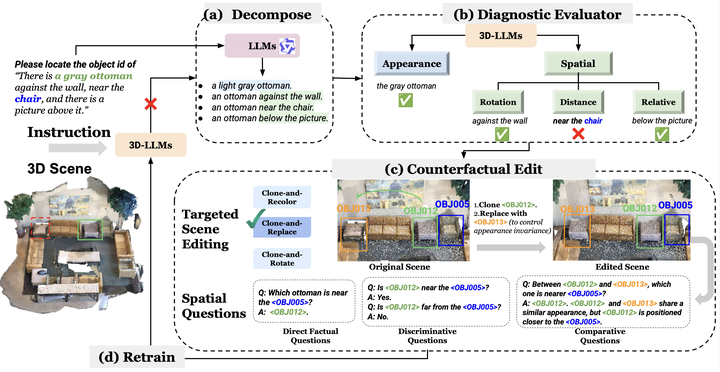
Despite recent progress in 3D-LLMs, they remain limited in accurately grounding language to visual and spatial elements in 3D environments. This limitation stems in part from training data that focuses on language reasoning rather than spatial understanding due to scarce 3D resources, leaving inherent grounding biases unresolved. To address this, we propose 3D scene editing as a key mechanism to generate visual counterfactuals that mitigate these biases through fine-grained spatial manipulation, without requiring costly scene reconstruction or large-scale 3D data collection. Furthermore, to make these edits targeted and directly address the specific weaknesses of the model, we introduce DEER-3D, an error-driven framework that diagnoses grounding failures and generates targeted counterfactual training supervision via a structured “Decompose, Diagnose, Edit, and Retrain” loop. Specifically, given a grounding failure, DEER-3D first identifies the predicate-level error (e.g., attribute or spatial relation). It then performs minimal predicate-aligned scene edits, such as recoloring or repositioning, and constructs aligned question-answer pairs that explicitly target the failed predicate, forming targeted counterfactual training examples. We evaluate our editing pipeline across multiple benchmarks for 3D grounding and scene understanding tasks, consistently demonstrating improvements across all grounding datasets through iterative refinement (4-6% gains). DEER-3D underscores the effectiveness of targeted, error-driven scene editing in bridging linguistic reasoning with spatial grounding in 3D LLMs.